Tuesdays with Dorie baking through Baking Chez Moi
by Dorie Greenspan
This cranberry crackle tart may look fancy, but really, it is unbelievably simple.
The filling is made up of just two egg whites and some sugar and salt, and whipped until soft peaks are formed. Then fresh cranberries are carefully folded in. Next time, I would add more cranberries.
The meringue mixture is placed in a pre-cooked tart shell made with a sweet tart dough that has been spread with jam - Dorie suggests chunky cherry, raspberry, or strawberry. I used a sour cherry and rhubarb jam.
I used the back of a spoon, by pressing it into the filling and lifting up, to give it it's fluffy, swirly texture.
It may not look like much, even Dorie mentions in the book that this tart is homey looking.
This made for a nice light dessert after our always, overabundant Thanksgiving meal. Everyone said they enjoyed it - I may have liked it more if I used more cranberries and jam. I found it to be rather bland.
Visit my fellow bakers to see how they fared with this recipe by clicking here.
It is the rule of TWD not to post the recipes here on our blogs. However, the recipe can be found online here.
Saturday, November 29, 2014
TWD | Baking Chez Moi | Cranberry Crackle Tart
Thursday, November 27, 2014
The Cottage Cooking Club | November Recipes
The CCC cooking their way through Veg Everyday
by Hugh Fearnley-Whittingstall
Rutabaga "Farrotto"
The actual recipe is named Rutabaga (or Swede - depending on if you have the US or UK version of the book) "Speltotto". It's a play on risotto, a rice dish - here Hugh substitutes spelt for the rice.
I could not find pearled spelt, so I opted for pearled farro. It is mentioned in the book that pearled barley could be substituted, but reading the packages, barley can take up to an hour to cook, as where the farro only takes about twenty minutes - this is why I chose the farro over the barley, and I was happy with the outcome.
Who doesn't love a good baked potato? Twice-baked or otherwise.
They are peeled while still warm for easier peeling- so it's said. It's a tedious job to say the least. It was not till I was just about done, that I found that if I squashed the chestnut with the palm of my hand, it helped release the skin from the meat.
I ended up having to make only half the recipe, for after the chestnuts were cooked and peeled, my pound of chestnuts yielded only seven and a quarter ounces of chestnut meat! The recipe calls for fourteen ounces.
Roasting and peeling the chestnuts was the hardest part - using precooked chestnuts, this soup will come together fairly quickly.
Onions are sautéed in a bit of olive oil and butter until soft, then some sage and garlic are added and cooked for another minute. Even though I halved the recipe, I used the full amount of sage called for in the recipe, and doubled the amount of garlic (the recipes in this book seem to need an extra boost when it comes to the herbs and spices).
Vegetable broth is added to the onion mixture, along with most of the chestnuts (a few are reserved for garnish), salt and pepper, and is simmered for about fifteen more minutes. The soup is cooled slightly, then transferred to a blender or food processor, and puréed. I prefer to use an immersion blender, for transferring hot liquids back and forth, to me, is an accident waiting to happen - and makes for less clean up! Crème fraîche is added to the purée with any needed additional seasonings. I liked the soup the way it was, so I omitted adding the crème fraîche.
The soup is garnished with fried sage leaves and sliced chestnuts. The recipe states to finish it off with a drizzle of olive oil. I used some non-fat Greek yogurt thinned with milk; though the drizzle of oil makes for a very pretty presentation.
I would make this one again - only using the packaged precooked chestnuts next time.
Crostini. It's just a fancy name for toast that is topped with your choice of deliciousness.
I make these often to go with a roasted butternut squash soup that I make. The recipe in the book has you drizzle olive oil over the bread, sprinkle with some salt, then bake until golden. Hugh lists in the book several toppings to choose from.
My version, I butter the bread and toast until golden (I did do one as Hugh suggests - the center one, with olive oil and a sprinkling of salt).
After toasting the bread, my version is turned over (Hugh's is removed from the oven and is spread with the topping of your choice), and is then topped with cheese, thyme, sage, salt and pepper. They are popped back in the oven just until the cheese is melted. I normally make these with Gruyère cheese. However, this evening I used white cheddar, for this is what I had on hand; either way, they are delicious.
Hugh suggests to top only one half of the crostini, leaving the plain half as a palate cleanser. I can't say how Hugh's version compares to mine, for my husband woofed it down - probably did not even notice that only half the bread was topped with the cheesy goodness. I'm confident that it was just as tasty.
Patatas Bravas
Wow. Incredible flavor. The Mr. even gave it an A+.
The book states that this is a classic Spanish tapa. We didn't go the appetizer route with this, we served it alongside our baked chicken and steamed broccoli; and the leftovers were great with our pouched eggs the next morning.
This dish consists of a homemade spicy tomato sauce (delish!) and fried potatoes.
The sauce is made from sautéing some onions, thyme, garlic and a hot chile pepper. Then a can of tomatoes, some paprika, sugar, salt and pepper are simmered together until you have a nice, rich, thick looking sauce. This is kept warm, while you make the potatoes.
Boiled (slightly undercooked) cubed potatoes are sautéed in oil until they are golden and crispy, and given a sprinkling of salt.
The potatoes are then placed in a serving dish and topped with the (out ofthis my world) spicy tomato sauce, and garnished with some parsley (or in my case, thyme).
This was the favorite of the month.
We have been asked not to publish the recipes here on our blogs. We encourage you to go out and purchase the book and join us on this fun and healthy adventure!
by Hugh Fearnley-Whittingstall
My selections for November:
Rutabaga "Farrotto"
Twice-Baked Potatoes
Chestnut and Sage Soup
Crostini
Patatas Bravas
Click here for the complete list of August's recipe options.
Rutabaga "Farrotto"
I could not find pearled spelt, so I opted for pearled farro. It is mentioned in the book that pearled barley could be substituted, but reading the packages, barley can take up to an hour to cook, as where the farro only takes about twenty minutes - this is why I chose the farro over the barley, and I was happy with the outcome.
Cubed rutabaga is mixed in with some sautéed onions and garlic. The farro (or spelt), is stirred in until it is covered in oil and butter from the onion mixture. As with risotto, warmed broth is added in next, about a cup at a time, and stirring until the grains have absorbed all the liquid, before adding the next cup of broth. After all the broth has been added and the grains and rutabaga are tender (al a dente), some parsley and cheese are mixed in along with some salt, pepper, and nutmeg.
The Mr. deemed this "good & hearty". He took the leftovers to work for him and a co-worker; who commented "this must be healthy. It's on the bland side." Just goes to show you, how individual tastes vary.
Twice-Baked Potatoes
Who doesn't love a good baked potato? Twice-baked or otherwise.
For me, baked potatoes are an easy and quick comfort food. Twice-baked are a bit more indulgent and take a little longer - but not much, and are worth it. Served with a salad, you have an easy weeknight meal.
For twice-baked potatoes, you cut the top off of a baked potato and scoop out the flesh, mix it with some butter and sour cream (or Greek yogurt as I did), and add in your favorite fixings - this can be anything from bacon to broccoli - use your imagination. Replace the filling into the shell, mounding it, and bake again until heated through.
For this recipe, scallions, smoked Gouda, and a generous dash of cayenne pepper where my choice of fixings. This would also be delicious with sautéed mushrooms added in, as I did with these potatoes in a previous post.
Add extra cheese and scallions (or chives) for garnish, just before serving. I added extra cheese on top, gave it another minute or two in the oven - just long enough for it to melt, then I added sliced scallions and some Gouda hearts.
Chestnut and Sage Soup
A lovely chestnut soup topped with crisp fried sage leaves, chopped chestnuts, and a spattering of yogurt.
The recipe states you can use vacuum-packed precooked chestnuts. I wanted to try my hand at roasting my own - though it is mentioned in the book to blanch, peel and simmer the chestnuts. But we all know roasting brings out a much deeper flavor in foods than boiling ever would.
♪Chestnuts roasting on an open fire..♪
Well not quite... these were roasted in the oven... and an electric oven at that.
Before the chestnuts are roasted, they are first soaked in warm water for about half an hour. Then the flat side of the chestnut is scored with an X (the skins are tough - you will need a very sharp knife). They are then placed on a baking sheet, flat side up, and roasted until the skins curl back at the X, and the chestnuts are tender.
They are peeled while still warm for easier peeling- so it's said. It's a tedious job to say the least. It was not till I was just about done, that I found that if I squashed the chestnut with the palm of my hand, it helped release the skin from the meat.
I ended up having to make only half the recipe, for after the chestnuts were cooked and peeled, my pound of chestnuts yielded only seven and a quarter ounces of chestnut meat! The recipe calls for fourteen ounces.
Roasting and peeling the chestnuts was the hardest part - using precooked chestnuts, this soup will come together fairly quickly.
Onions are sautéed in a bit of olive oil and butter until soft, then some sage and garlic are added and cooked for another minute. Even though I halved the recipe, I used the full amount of sage called for in the recipe, and doubled the amount of garlic (the recipes in this book seem to need an extra boost when it comes to the herbs and spices).
Vegetable broth is added to the onion mixture, along with most of the chestnuts (a few are reserved for garnish), salt and pepper, and is simmered for about fifteen more minutes. The soup is cooled slightly, then transferred to a blender or food processor, and puréed. I prefer to use an immersion blender, for transferring hot liquids back and forth, to me, is an accident waiting to happen - and makes for less clean up! Crème fraîche is added to the purée with any needed additional seasonings. I liked the soup the way it was, so I omitted adding the crème fraîche.
The soup is garnished with fried sage leaves and sliced chestnuts. The recipe states to finish it off with a drizzle of olive oil. I used some non-fat Greek yogurt thinned with milk; though the drizzle of oil makes for a very pretty presentation.
I would make this one again - only using the packaged precooked chestnuts next time.
Crostini
Crostini. It's just a fancy name for toast that is topped with your choice of deliciousness.
I make these often to go with a roasted butternut squash soup that I make. The recipe in the book has you drizzle olive oil over the bread, sprinkle with some salt, then bake until golden. Hugh lists in the book several toppings to choose from.
My version, I butter the bread and toast until golden (I did do one as Hugh suggests - the center one, with olive oil and a sprinkling of salt).
After toasting the bread, my version is turned over (Hugh's is removed from the oven and is spread with the topping of your choice), and is then topped with cheese, thyme, sage, salt and pepper. They are popped back in the oven just until the cheese is melted. I normally make these with Gruyère cheese. However, this evening I used white cheddar, for this is what I had on hand; either way, they are delicious.
Hugh suggests to top only one half of the crostini, leaving the plain half as a palate cleanser. I can't say how Hugh's version compares to mine, for my husband woofed it down - probably did not even notice that only half the bread was topped with the cheesy goodness. I'm confident that it was just as tasty.
Toasted bread and cheese. Need I say more?
Patatas Bravas
Wow. Incredible flavor. The Mr. even gave it an A+.
The book states that this is a classic Spanish tapa. We didn't go the appetizer route with this, we served it alongside our baked chicken and steamed broccoli; and the leftovers were great with our pouched eggs the next morning.
This dish consists of a homemade spicy tomato sauce (delish!) and fried potatoes.
The sauce is made from sautéing some onions, thyme, garlic and a hot chile pepper. Then a can of tomatoes, some paprika, sugar, salt and pepper are simmered together until you have a nice, rich, thick looking sauce. This is kept warm, while you make the potatoes.
Boiled (slightly undercooked) cubed potatoes are sautéed in oil until they are golden and crispy, and given a sprinkling of salt.
The potatoes are then placed in a serving dish and topped with the (out of
This was the favorite of the month.
To see what recipes the other members chose for this month, head over to the November LYL post on the CCC website, by clicking here.
We have been asked not to publish the recipes here on our blogs. We encourage you to go out and purchase the book and join us on this fun and healthy adventure!
Labels:
bread,
cheese,
chestnuts,
cottage cooking club,
crostini,
croutons,
farro,
grains,
gruyère,
potatoes,
risotto,
rutabaga,
soup,
spelt,
tapas,
tomato sauce,
twice-baked potatoes,
veg everyday
Wednesday, November 19, 2014
Wok Wednesdays | Stir-Fried Cauliflower with Rice Wine
WW wokking through Stir-Frying to the Sky's Edge
by Grace Young
Here is an incredibly easy and surprisingly tasty stir-fry. I say surprisingly, because really, there isn't much to this recipe, as you will see below.
by Grace Young
Here is an incredibly easy and surprisingly tasty stir-fry. I say surprisingly, because really, there isn't much to this recipe, as you will see below.
Mise en place.
Bowl 1: Ginger
Bowl 2: Blanched cauliflower
Bowl 3: Rice wine (I used dry sherry), rice vinegar
Bowl 4: Salt
I had some sliced scallions hanging out in the fridge, so I tossed a handful on for a little color; taste wise - the cauliflower doesn't need it. Who knew that so few ingredients would add so much to this under-appreciated vegetable.
We are asked not to post
the recipes here on our blog. If you would like the recipe, you will
find it on page 214 of Stir-Frying to the Sky's Edge, which you
can purchase at your local bookstore or find it at your local library. I
highly recommend purchasing the book - you won't be disappointed.
The recipe is also available here on Google books.
Wok Wednesdays is an online cooking group. If you would like information about joining us, click here, or visit us on Facebook. Would love for you to wok along with us!
Tuesday, November 18, 2014
TWD | Baking with Julia | Amaretti
Tuesdays with Dorie baking through Baking with Julia
by Dorie Greenspan
Contributing Baker: Nick Malgieri
The book states that amaretti means "little bitter things", due to the use of sweet and bitter almonds in the dough; and that bitter almonds cannot be imported into the United States*.
These not so little cookies of mine, are made from only a few ingredients; four to be exact, and one of them being optional: almond paste, sugar, egg whites, and pine nuts (I used sliced almonds).
The almond paste is mixed with the sugar in two increments until the paste turns into very fine crumbs; next, the egg whites are mixed in. Bam! Done. How easy is that?!! So easy, it felt as though something was missing.
The dough is transferred to a pastry bag and small mounds are placed on a baking sheet that has been lined with parchment, about one and a half inches apart. I obviously made mine too large, for I only yielded a baker's dozen, as where the recipe states it makes about three dozen! Oops.
Before baking, the cookies are dabbed with a wet towel to remove the points and ridges made from the pipping tip; this also helps produce the crinkly top. If using the optional nuts, they are applied at this time. I topped a third of my cookies with almonds, another third with powdered sugar, and left the last plain.
They are baked in a 325° oven for about twenty minutes.
The cookies did stick to the parchment, as noted in the book that this could happen. I have a very thin metal spatula that I used to remove them - it worked OK. It is recommended to wet the underside of the parchment, using a pastry brush with hot water, and allowed to sit for a few seconds, until the cookies can be released. I started with this method, but when I lifted the parchment paper, the powdered sugar started falling off my cookies.
The cookies were wonderful the day they were made, but I liked them even more a day or two later. They became a little more crisp on the outside, with a wonderfully chewy center. They do become rather dry and too crispy, after day two.
These were so easy, so sweet, and so dangerously good (not knowing just how dangerous they could be!)
*Of course I had to find out why bitter almonds were not allowed to be imported into the US as mentioned in the book. Did you know, that bitter almonds contain a naturally occurring toxic chemical, hydrogen cyanide? This chemical has serious side effects such as slowing of the nervous system, breathing problems, and death. According to WebMD, they advise not using bitter almond. Ah yeah...
In my research, I ran across this current recall from Whole Foods for said almonds, imported from Italy and Spain??? Hmmm - maybe import restrictions have eased since 1996 - when this book was printed.
Do head over to the TWD website by clicking here to see the results of my fellow bakers.
by Dorie Greenspan
Contributing Baker: Nick Malgieri
The book states that amaretti means "little bitter things", due to the use of sweet and bitter almonds in the dough; and that bitter almonds cannot be imported into the United States*.
These not so little cookies of mine, are made from only a few ingredients; four to be exact, and one of them being optional: almond paste, sugar, egg whites, and pine nuts (I used sliced almonds).
The almond paste is mixed with the sugar in two increments until the paste turns into very fine crumbs; next, the egg whites are mixed in. Bam! Done. How easy is that?!! So easy, it felt as though something was missing.
The dough is transferred to a pastry bag and small mounds are placed on a baking sheet that has been lined with parchment, about one and a half inches apart. I obviously made mine too large, for I only yielded a baker's dozen, as where the recipe states it makes about three dozen! Oops.
Before baking, the cookies are dabbed with a wet towel to remove the points and ridges made from the pipping tip; this also helps produce the crinkly top. If using the optional nuts, they are applied at this time. I topped a third of my cookies with almonds, another third with powdered sugar, and left the last plain.
They are baked in a 325° oven for about twenty minutes.
The cookies did stick to the parchment, as noted in the book that this could happen. I have a very thin metal spatula that I used to remove them - it worked OK. It is recommended to wet the underside of the parchment, using a pastry brush with hot water, and allowed to sit for a few seconds, until the cookies can be released. I started with this method, but when I lifted the parchment paper, the powdered sugar started falling off my cookies.
The cookies were wonderful the day they were made, but I liked them even more a day or two later. They became a little more crisp on the outside, with a wonderfully chewy center. They do become rather dry and too crispy, after day two.
Though I enjoyed them all, the powdered sugar ones were my favorite.
These were so easy, so sweet, and so dangerously good (not knowing just how dangerous they could be!)
*Of course I had to find out why bitter almonds were not allowed to be imported into the US as mentioned in the book. Did you know, that bitter almonds contain a naturally occurring toxic chemical, hydrogen cyanide? This chemical has serious side effects such as slowing of the nervous system, breathing problems, and death. According to WebMD, they advise not using bitter almond. Ah yeah...
In my research, I ran across this current recall from Whole Foods for said almonds, imported from Italy and Spain??? Hmmm - maybe import restrictions have eased since 1996 - when this book was printed.
Do head over to the TWD website by clicking here to see the results of my fellow bakers.
Labels:
almonds,
amaretti,
baking with julia,
cookies,
dorie greenspan,
julia child,
tuesdays with dorie,
twd
Tuesday, November 11, 2014
TWD | Baking Chez Moi | Palets de Dames, Lille Style
Tuesdays with Dorie baking through Baking Chez Moi
by Dorie Greenspan
I decided to make these pretty much at the last minute, and they came together rather quickly, aside from the dough needing an hour or so rest in the refrigerator to firm up a bit - just long enough for me to run to the store to grab something for dinner.
This simple dough is made from butter, sugar, salt, eggs, vanilla extract, and all purpose flour. As with most cookie doughs, you first beat the butter until creamy, then add the sugar and salt and beat until combined. The eggs are added one at a time and mixed until incorporated. The vanilla extract is added next, then the flour is added in three increments, until combined.
The dough is then chilled for at least one hour or until firm enough to shape.
Once the dough has chilled, balls of dough (about two teaspoons each) are placed on cookie sheet about two-inches apart, to allow for spreading (mine did not spread hardly at all). They are baked for about eight minutes, or when you see a slight brownness around the edge of the cookies.
The recipe states to transfer the cookies to a rack and allow to cool to room temperature. I always leave them on the baking sheet to cool, ever since I read somewhere.. that bakeries do not transfer their cookies to racks.
Once the cookies have cooled, they are ready to be iced. This icing consists of powdered sugar, milk, and lemon juice. The recipe states that if it needs to be thinner, add more milk - a drop at a time. I added more lemon juice to thin it, and next time, I'm thinking I'll use mostly, or all juice and omit the milk, for a more lemony flavor.
Some of my fellow bakers who happen to be in another on-line cooking group - French Fridays with Dorie, have already made this recipe; and reading their posts on this, it was mentioned the bottoms of the cookies were frosted, to give the look of a top (child's toy) or parasol; though the recipe given to us (before the book was released), states to dip one side into the icing - so I just assumed it was the domed side.
After dipping the cookies into the icing, I added a bit of lemon zest to the top for a little pizazz - which was very last minute. Next time, I would zest the lemon ahead of time and spread it out to allow it to dry a bit to make it easier to sprinkle atop the cookies - I had issues with it wanting to clump, with it being so moist.
I made only half the recipe - I wish I had made the full recipe - though grateful I did not.
We have been asked not to post the recipes from this book on our blogs. However, the recipe is available on Amazon - you can find it by clicking here and scrolling down the page.
Do venture over to the TWD site for the links of my fellow bakers to read their thoughts on this recipe.
by Dorie Greenspan
Our Tuesdays with Dorie group is starting with a new book which was just released at the end of October - Baking Chez Moi - Recipes from My Paris Home to Your Home Anywhere, by Dorie Greenspan; and this is the first recipe from the book, Palets de Dames, Lille Style (Lille - a city in France).
We still have just under two years left with Baking with Julia, and will be posting on opposite weeks. That means a TWD recipe every week, instead of every other week. Oh my... anyone in need of a few baked goods?
These cute little cookies have a fancy name, but basically they are a cakey sugar cookie with a simple confectioner's sugar glaze.
I decided to make these pretty much at the last minute, and they came together rather quickly, aside from the dough needing an hour or so rest in the refrigerator to firm up a bit - just long enough for me to run to the store to grab something for dinner.
This simple dough is made from butter, sugar, salt, eggs, vanilla extract, and all purpose flour. As with most cookie doughs, you first beat the butter until creamy, then add the sugar and salt and beat until combined. The eggs are added one at a time and mixed until incorporated. The vanilla extract is added next, then the flour is added in three increments, until combined.
The dough is then chilled for at least one hour or until firm enough to shape.
Once the dough has chilled, balls of dough (about two teaspoons each) are placed on cookie sheet about two-inches apart, to allow for spreading (mine did not spread hardly at all). They are baked for about eight minutes, or when you see a slight brownness around the edge of the cookies.
The recipe states to transfer the cookies to a rack and allow to cool to room temperature. I always leave them on the baking sheet to cool, ever since I read somewhere.. that bakeries do not transfer their cookies to racks.
Once the cookies have cooled, they are ready to be iced. This icing consists of powdered sugar, milk, and lemon juice. The recipe states that if it needs to be thinner, add more milk - a drop at a time. I added more lemon juice to thin it, and next time, I'm thinking I'll use mostly, or all juice and omit the milk, for a more lemony flavor.
Some of my fellow bakers who happen to be in another on-line cooking group - French Fridays with Dorie, have already made this recipe; and reading their posts on this, it was mentioned the bottoms of the cookies were frosted, to give the look of a top (child's toy) or parasol; though the recipe given to us (before the book was released), states to dip one side into the icing - so I just assumed it was the domed side.
After dipping the cookies into the icing, I added a bit of lemon zest to the top for a little pizazz - which was very last minute. Next time, I would zest the lemon ahead of time and spread it out to allow it to dry a bit to make it easier to sprinkle atop the cookies - I had issues with it wanting to clump, with it being so moist.
I made only half the recipe - I wish I had made the full recipe - though grateful I did not.
We have been asked not to post the recipes from this book on our blogs. However, the recipe is available on Amazon - you can find it by clicking here and scrolling down the page.
Do venture over to the TWD site for the links of my fellow bakers to read their thoughts on this recipe.
Labels:
3,
baking chez moi,
dorie greenspan,
lemon,
sugar cookies,
tuesdays with dorie,
twd
Tuesday, November 4, 2014
TWD: Alsatian Onion Tart
Tuesdays with Dorie baking through Baking with Julia
by Dorie Greenspan
Contributing Baker: Michel Richard
Well, this has the appearance more like a pizza than a tart - at least in my mind. When I think of a tart, I conjure up images of dough that has been pressed into a tart pan, and after baking, it comes out with beautiful ruffled edges.
OK. So looks aren't everything.
by Dorie Greenspan
Contributing Baker: Michel Richard
Well, this has the appearance more like a pizza than a tart - at least in my mind. When I think of a tart, I conjure up images of dough that has been pressed into a tart pan, and after baking, it comes out with beautiful ruffled edges.
OK. So looks aren't everything.
Taste. This does have taste going for it. It was quite delicious.
This was very easy to make. You start with preparing the base (I did this while my onions were cooking) by rolling out puff pastry dough (yes - puff pastry - no tart or pizza dough here) until it is very thin, about an eighth of an inch, but no more than a quarter of an inch, and using a sharp knife, cut the pastry into a circle (I'm sure any shape you choose would work), about twelve inches in diameter.
The dough is pricked all over with a fork, this will keep the puff pastry from, well, puffing... it's all about the flavor. The dough is then refrigerated until you are ready to top it with the onion mixture.
The onion mixture is made from four very large onions that have been diced. I only used three, and was in a hurry, so I sliced the onions instead of dicing, and had more than enough. The onions are cooked in chicken broth until very soft, and then cooled, at which time you add a few tablespoons of heavy cream (I used half and half) and salt and pepper.
The recipe calls for slab bacon to be diced and par-boiled. The store I went to does not have slab bacon, so I purchased thick-cut bacon slices - which worked just fine. I skipped the par-boiling of the bacon, and cooked it up normally (undercooked it a bit), then diced it.
The tart was now ready for assembly! The pastry is first topped with the onion mixture, then the bacon is scattered over the top and pressed into the onions a bit, to help keep them from burning too much while baking. I had some diced jalapeño left over from the chili I made the night before, so I tossed those on as well - a good call if I do say so myself - it provided a nice spicy kick that I love. The tart is baked in a three-hundred and fifty degree oven until golden brown.
This was delicious, and would make for a lovely appetizer; though it can't really be made ahead of time for the bottom crust gets a bit soggy after sitting. It is easy enough to throw together at the last minute if you make the onions, cook the bacon, and prep the dough ahead of time - then assemble and toss it in the oven just before serving.
I was thinking a rectangular shaped tart would be pretty...
Don't forget to check out the results of my fellow bakers also! You will find their links by clicking here, or by going to the Tuesdays with Dorie website and looking for the BWJ LYL: Alsatian Onion Tart link.
Labels:
3,
bacon,
baking with julia,
dorie greenspan,
julia child,
onion,
pizza,
puff pastry,
tart,
tuesdays with dorie,
twd
Tuesday, October 28, 2014
The Cottage Cooking Club | October Recipes
The CCC cooking their way through River Cottage Veg
by Hugh Fearnley-Whittingstall
Warm Salad of Mushrooms and Roasted Squash
Close your eyes, and imagine little cubes of blue cheese scattered throughout this most delicious salad of roasted squash, sautéed mushrooms, and arugula, that has been dressed with a balsamic vinaigrette.
I was lucky I had enough roasted squash for the salad, for I could not stop picking at it while it cooled; I'm a sucker for anything roasted, especially squash.
Cooled? - you may be asking. This is supposed to be a warm salad... The squash cooked quicker than expected and I could not resist sneaking a few bites (OK, a lot) while prepping the rest of the salad.
This is the second recipe in as many months that we used roasted squash in a recipe. I truly am amazed at just how much flavor the squash picks up from the herbs (sage) that are left whole, and the garlic (in this recipe) was thickly sliced, though left whole (with skin on) in a previous recipe.
No cheese? No worries! I had maybe three or four bites left to eat before I realized I forgot to add the cheese! Dang! As much as I love a creamy blue, this salad tasted great without it.
Throughout the rest of the evening, I kept thinking to myself, mmm - that was really good.
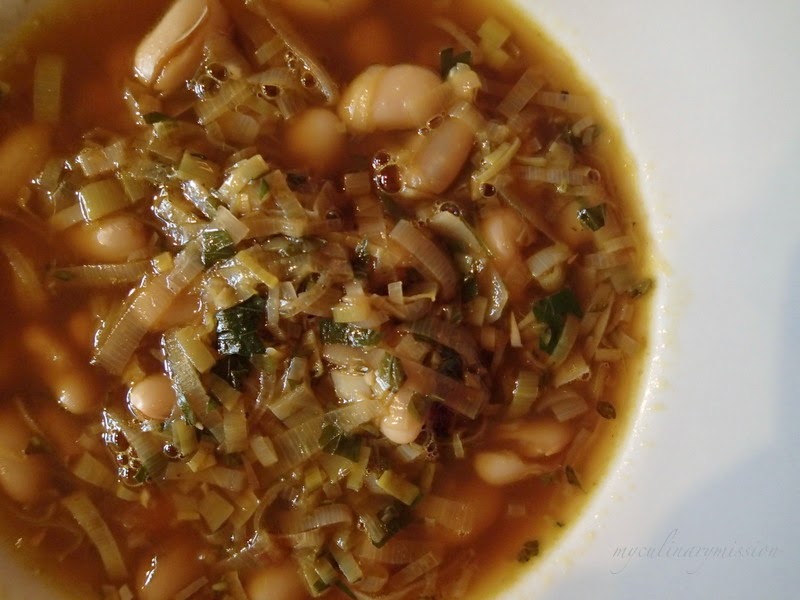
Cannellini Bean and Leek Soup with Chile Oil
The chile oil is made from simmering chile peppers, thyme, and garlic in olive oil. The instructions say to remove the membrane and seeds from the pepper and slice. I sliced horizontally, so it was more minced than sliced. I think Hugh must have meant to slice the peppers lengthwise for my peppers (and everything else) charred. My oil never turned red and had a burnt taste to it. Total fail on the oil part of this recipe. It was not a good day in the kitchen for me, as you may know if you read my post on French bread (the bread, shown below).
This soup is made up of leeks, thyme, bay leaf, garlic, vegetable stock, cannellini beans, oregano, and parsley. It comes together rather quickly (no long simmering times) and makes for a delicious weeknight dinner.
The leeks, thyme, and bay leaf are sautéed first until the leeks are tender, then the garlic is added and cooked for just another minute or so. The broth is added along with the oregano, parsley, salt, and pepper, and simmered gently for twenty minutes. Bam! Done. The soup is now ready to be served with a trickle of chile oil - if it had turned out.
The soup, it was a success - and it tasted even better the following day.
Carrot, Orange, and Cashews
I knew I would like this - I love anything citrus.
This salad of sort, is made up of oranges, carrots, toasted cashews, and cumin seed, with a splash of oil and vinegar, and a sprinkling of salt and pepper. I did not have cumin seed, so I subbed celery seed.
I will make a couple of changes the next time a make this. I would pass on toasting the cashews - I prefer them raw; and I would julienne the carrots finer using a kinpira peeler, for the thick carrots were awkward to eat - this would not be a good choice for a first date meal! I took the leftovers to my sister and she said the same; she liked the salad, except for the thickness of the carrots.
This was a wonderful dish, and can only be made better by using oranges that are in season.
Baby Beet Tarte Tatin
They say you feast with your eyes first...
It may not look like much in the beginning, but once it is turned out and dressed with the vinaigrette, it is absolutely gorgeous.
Hugh has a recipe for a "rough puff pastry" that is a cheater version of true homemade puff that you can use. I opted for store-bought - and by store-bought I mean this brand - it is as close to homemade as one can get.
This was a first for me, eating the skin of the beet. I have always skinned them. I must have re-read that recipe again and again, looking for when the beets were to be skinned - peeled before cooking, or slipped off afterward. I tried slipping them off after they were roasted, but it was not happening. And after a quick Google search, there really is no need to peel your beets if they are young - older beets, the skin can be a little tough.
The beets are first roasted until tender in a mixture of butter (I used all oil, for I thought I was out of butter - gasp! though I did find it a day later - in plain sight of course), oil, cider vinegar, sugar, and salt & pepper. Once the beets are ready, they are arranged cut side up and covered with the puff pastry and returned to the oven until the pastry is puffed and golden.
Once the tarte is cooled, it is turned out onto a serving platter.
I wish I had left the tips on a few of the beets - it would have made for a more artistic design - and I'm thinking, using red and golden beets would be beautiful too. Next time - and I do hope there will be a next time.
After the tarte has been placed on its serving platter, it is dressed with a vinaigrette made of shallots (or scallions can be used), English mustard, cider vinegar, canola oil, sugar, and parsley.
We had this for dinner alongside a basic green salad. This would also make for a fun and delicious appetizer or light lunch.
Unfortunately, it cannot be made ahead of time for the bottom crust will become soggy. We had leftovers the next evening, in which I warmed it in a 350°F oven for about half an hour. Aside from a soggy bottom (despite being re-heated on a rack that was placed over a baking sheet), we thought it tasted even better the next day.
Pumpkin and Raisin Tea Loaf
This delightful bread is made from muscovado sugar (I used dark brown sugar), eggs, raw pumpkin flesh (I used canned), lemon juice & zest, raisins, ground almonds, self-rising flour, cinnamon, and nutmeg.
I do like Hugh's idea of lining the loaf pan with parchment - something I had never thought to do when baking bread; it made for easy removal.
I'm glad I decided to use the raisins I had on hand - Sunmaid Mixed Jumbo Raisins - I think it made for a very pretty raisin-studded loaf.
This bread turned out quite moist despite not having any added oil or butter, and quite tasty; and is so frigging good toasted and buttered - maybe the only way it should be eaten.
Vegeree
Vegeree - you may be thinking it sounds familiar. This is actually a take on kedgeree, the curried rice dish made with fish, cream, and hard-boiled eggs. Here Hugh omits the cream, swaps out the fish with eggplant, and has added some zucchini as well.
I had some butternut squash I needed to use, so I tossed that in too, along with some garlic. The vegetables are tossed together with oil, salt, pepper, and curry powder (I also added a bit of cumin), and roasted until the vegetables are tender.
While the vegetables are roasting the rice and hard-boiled eggs are cooked.
As I have said before, I love any and all roasted vegetables. So there is no surprise that this was a hit we me - hubby seems to have an aversion to anything onion, or anything that even resembles an onion..
As all roasted vegetables are, this was easy and quick to make. Just tossed the prepped vegetables with some olive oil, salt and pepper, and a few sprigs of thyme, and roasted until tender - around a half hour or so, stirring at least once half way through.
The recipe calls for a drizzle of lemon juice and fresh thyme before serving. However, The Mr. also is not a fan of citrus used in this way. So instead of squeezing lemon juice over the roasted vegetables as the recipe calls for, I served the vegetables with wedges of lemon alongside. The lemon adds a lightness, and bright taste to the dish.
The broccoli is first blanched to soften it slightly. The vinaigrette is added to the still warm broccoli and allowed to sit until cooled. Just before serving, toasted sesame seeds (as you can see, I did not toast mine) and sliced scallions are scattered over the top.
This was OK. The vinaigrette has good flavor. I think I would have preferred this served warm as a side dish, rather than at room temperature as a salad.
This would have been a lot more visually appealing if I did not forget to scatter over the cheese! Gahhh! I can't believe I forgot - again!
For this salad, slivered garlic (as usual - I doubled up on the garlic) is sautéed in a tablespoon of oil from the marinated artichoke hearts, then the hearts themselves are added and cooked for a very short time before the beans are added, and everything is heated through.
After removing the pan from the heat, lemon juice, salt, and pepper are added and combined, then this mixture is placed on top of salad greens.
Wait a minute.. what about dressing for the salad? This would make for a rather dry salad with no dressing. Was the lemon juice supposed to stand in for a dressing? The beans pretty much soaked the lemon juice all up. I made a quick, light vinaigrette - I mixed up some olive oil, champagne vinegar, lemon juice, and a dash of salt.
Again, another OK recipe. The cheese was my favorite part. To my surprise, The Mr. said he liked it - he does love his beans.
Well, I made nine out of the ten recipes I committed to this month- time just got away. With the holidays upon us, I don't see myself committing to ten each month until at least January.
We have been asked not to publish the recipes here on our blogs. We encourage you to go out and purchase the book and join us on this fun and healthy adventure! (Some of the recipes from the book are posted on-line on Hugh's website [and others], just do a Google search.)
by Hugh Fearnley-Whittingstall
October Recipe Choices:
Warm Salad of Mushrooms and Roasted Squash
Cannellini Bean and Leek Soup with Chile Oil
Carrot, Orange, and Cashews
Baby Beet Tarte Tatin
Pumpkin and Raisin Tea loaf
Vegeree
Roasted Brussels Sprouts with Shallots
Broccoli Salad with Asian-Style Dressing
White Beans with Artichokes
Kale and Onion Pizza
Cannellini Bean and Leek Soup with Chile Oil
Carrot, Orange, and Cashews
Baby Beet Tarte Tatin
Pumpkin and Raisin Tea loaf
Vegeree
Roasted Brussels Sprouts with Shallots
Broccoli Salad with Asian-Style Dressing
White Beans with Artichokes
Warm Salad of Mushrooms and Roasted Squash
Close your eyes, and imagine little cubes of blue cheese scattered throughout this most delicious salad of roasted squash, sautéed mushrooms, and arugula, that has been dressed with a balsamic vinaigrette.
I was lucky I had enough roasted squash for the salad, for I could not stop picking at it while it cooled; I'm a sucker for anything roasted, especially squash.
Cooled? - you may be asking. This is supposed to be a warm salad... The squash cooked quicker than expected and I could not resist sneaking a few bites (OK, a lot) while prepping the rest of the salad.
This is the second recipe in as many months that we used roasted squash in a recipe. I truly am amazed at just how much flavor the squash picks up from the herbs (sage) that are left whole, and the garlic (in this recipe) was thickly sliced, though left whole (with skin on) in a previous recipe.
No cheese? No worries! I had maybe three or four bites left to eat before I realized I forgot to add the cheese! Dang! As much as I love a creamy blue, this salad tasted great without it.
Throughout the rest of the evening, I kept thinking to myself, mmm - that was really good.
Cannellini Bean and Leek Soup with Chile Oil
So excited to see new buds on my Thai hot pepper plant. :)
The chile oil is made from simmering chile peppers, thyme, and garlic in olive oil. The instructions say to remove the membrane and seeds from the pepper and slice. I sliced horizontally, so it was more minced than sliced. I think Hugh must have meant to slice the peppers lengthwise for my peppers (and everything else) charred. My oil never turned red and had a burnt taste to it. Total fail on the oil part of this recipe. It was not a good day in the kitchen for me, as you may know if you read my post on French bread (the bread, shown below).
This soup is made up of leeks, thyme, bay leaf, garlic, vegetable stock, cannellini beans, oregano, and parsley. It comes together rather quickly (no long simmering times) and makes for a delicious weeknight dinner.
The leeks, thyme, and bay leaf are sautéed first until the leeks are tender, then the garlic is added and cooked for just another minute or so. The broth is added along with the oregano, parsley, salt, and pepper, and simmered gently for twenty minutes. Bam! Done. The soup is now ready to be served with a trickle of chile oil - if it had turned out.
The soup, it was a success - and it tasted even better the following day.
Carrot, Orange, and Cashews
I knew I would like this - I love anything citrus.
This salad of sort, is made up of oranges, carrots, toasted cashews, and cumin seed, with a splash of oil and vinegar, and a sprinkling of salt and pepper. I did not have cumin seed, so I subbed celery seed.
I will make a couple of changes the next time a make this. I would pass on toasting the cashews - I prefer them raw; and I would julienne the carrots finer using a kinpira peeler, for the thick carrots were awkward to eat - this would not be a good choice for a first date meal! I took the leftovers to my sister and she said the same; she liked the salad, except for the thickness of the carrots.
The kinpira peeler - awesome tool.
This was a wonderful dish, and can only be made better by using oranges that are in season.
Baby Beet Tarte Tatin
They say you feast with your eyes first...
It may not look like much in the beginning, but once it is turned out and dressed with the vinaigrette, it is absolutely gorgeous.
Hugh has a recipe for a "rough puff pastry" that is a cheater version of true homemade puff that you can use. I opted for store-bought - and by store-bought I mean this brand - it is as close to homemade as one can get.
This was a first for me, eating the skin of the beet. I have always skinned them. I must have re-read that recipe again and again, looking for when the beets were to be skinned - peeled before cooking, or slipped off afterward. I tried slipping them off after they were roasted, but it was not happening. And after a quick Google search, there really is no need to peel your beets if they are young - older beets, the skin can be a little tough.
The beets are first roasted until tender in a mixture of butter (I used all oil, for I thought I was out of butter - gasp! though I did find it a day later - in plain sight of course), oil, cider vinegar, sugar, and salt & pepper. Once the beets are ready, they are arranged cut side up and covered with the puff pastry and returned to the oven until the pastry is puffed and golden.
Once the tarte is cooled, it is turned out onto a serving platter.
After the tarte has been placed on its serving platter, it is dressed with a vinaigrette made of shallots (or scallions can be used), English mustard, cider vinegar, canola oil, sugar, and parsley.
We had this for dinner alongside a basic green salad. This would also make for a fun and delicious appetizer or light lunch.
Unfortunately, it cannot be made ahead of time for the bottom crust will become soggy. We had leftovers the next evening, in which I warmed it in a 350°F oven for about half an hour. Aside from a soggy bottom (despite being re-heated on a rack that was placed over a baking sheet), we thought it tasted even better the next day.
Beets and puff pastry - enough said.
Pumpkin and Raisin Tea Loaf
So much for my thinking this was a quick-bread, that I was going to whip it out in no time in between my morning workout and a bike ride. One should never assume... it was a little more involved than I realized:
1. Grinding the almonds
2. Separating the eggs
3. Juicing and zesting of a lemon
4. Making my own self-rising flour (flour/baking powder/salt)
5. Whipping of the egg whites and folding the egg whites into the batter
6. A longer baking time (18 minutes more)
So much for that one bowl recipe I was thinking of too.
It's all good though - it was worth it.
This delightful bread is made from muscovado sugar (I used dark brown sugar), eggs, raw pumpkin flesh (I used canned), lemon juice & zest, raisins, ground almonds, self-rising flour, cinnamon, and nutmeg.
I do like Hugh's idea of lining the loaf pan with parchment - something I had never thought to do when baking bread; it made for easy removal.
I'm glad I decided to use the raisins I had on hand - Sunmaid Mixed Jumbo Raisins - I think it made for a very pretty raisin-studded loaf.
Vegeree
Vegeree - you may be thinking it sounds familiar. This is actually a take on kedgeree, the curried rice dish made with fish, cream, and hard-boiled eggs. Here Hugh omits the cream, swaps out the fish with eggplant, and has added some zucchini as well.
I had some butternut squash I needed to use, so I tossed that in too, along with some garlic. The vegetables are tossed together with oil, salt, pepper, and curry powder (I also added a bit of cumin), and roasted until the vegetables are tender.
While the vegetables are roasting the rice and hard-boiled eggs are cooked.
Hugh has an interesting way to cook the rice. First it is boiled uncovered until all the liquid has been absorbed by the rice, a damp kitchen towel (I used strong paper towels) is placed under the lid and cooks for ten minutes more on the lowest heat setting; then off heat, is allowed to sit for another five minutes.
I found all this fuss unnecessary. Cooking the rice according to the package directions would work just as well.
After everything is cooked, the rice and vegetables are tossed together, and then topped with the eggs and some fresh ground black pepper.
Traditionally, kedgeree is eaten at breakfast; I however, chose to serve our vegeree for dinner.
Roasted Brussels Sprouts with Shallots
As I have said before, I love any and all roasted vegetables. So there is no surprise that this was a hit we me - hubby seems to have an aversion to anything onion, or anything that even resembles an onion..
As all roasted vegetables are, this was easy and quick to make. Just tossed the prepped vegetables with some olive oil, salt and pepper, and a few sprigs of thyme, and roasted until tender - around a half hour or so, stirring at least once half way through.
The recipe calls for a drizzle of lemon juice and fresh thyme before serving. However, The Mr. also is not a fan of citrus used in this way. So instead of squeezing lemon juice over the roasted vegetables as the recipe calls for, I served the vegetables with wedges of lemon alongside. The lemon adds a lightness, and bright taste to the dish.
You can't go wrong with roasted vegetables of any kind. It's amazing how vegetables are transformed when roasted. They caramelize on the outside while becoming soft and tender, and develop a concentrated and sweetened flavor. If you haven't tried roasting your favorite vegetable, you're missing out.
Broccoli Salad with Asian-Style Dressing
I think this as more of a side-dish than a salad. The only ingredients are broccoli, green onion, sesame seeds, and a vinaigrette made from garlic, ginger, sugar, salt, pepper, rice vinegar, sesame oil, and soy sauce.
The broccoli is first blanched to soften it slightly. The vinaigrette is added to the still warm broccoli and allowed to sit until cooled. Just before serving, toasted sesame seeds (as you can see, I did not toast mine) and sliced scallions are scattered over the top.
This was OK. The vinaigrette has good flavor. I think I would have preferred this served warm as a side dish, rather than at room temperature as a salad.
White Beans with Artichokes
This would have been a lot more visually appealing if I did not forget to scatter over the cheese! Gahhh! I can't believe I forgot - again!
For this salad, slivered garlic (as usual - I doubled up on the garlic) is sautéed in a tablespoon of oil from the marinated artichoke hearts, then the hearts themselves are added and cooked for a very short time before the beans are added, and everything is heated through.
After removing the pan from the heat, lemon juice, salt, and pepper are added and combined, then this mixture is placed on top of salad greens.
The forgotten cheese.
Again, another OK recipe. The cheese was my favorite part. To my surprise, The Mr. said he liked it - he does love his beans.
Well, I made nine out of the ten recipes I committed to this month- time just got away. With the holidays upon us, I don't see myself committing to ten each month until at least January.
To see what recipes the other members chose for this month, head over to the September LYL post on the CCC website, by clicking here.
We have been asked not to publish the recipes here on our blogs. We encourage you to go out and purchase the book and join us on this fun and healthy adventure! (Some of the recipes from the book are posted on-line on Hugh's website [and others], just do a Google search.)
Subscribe to:
Posts (Atom)