Recipe contributed by Lauren Groveman
(Edited January 2015)
Note to TWD: This post published in 2011 before BWJ. This is not only the first recipe I made from the book, but my first try at bread making, aside from quick breads and rolls.

Eastern European Rye
Ahhhh... Julia Child. Many cooks have been inspired by her. I do recall catching her a few times on PBS and she was always a kick to watch - and I have to admit I loved the movie Julie & Julia with Meryl Streep; I even have the DVD.
I have had a longing to make fresh homemade bread but have always shied away due to my fear of yeast which I am slowly overcoming. I have had recent success with Parker House rolls and knotted dinner rolls which have given me the confidence to give this a try. I think it would be wonderful to have fresh bread to make sandwiches from. Andy always orders his sandwiches on rye so I chose the Eastern European Rye loaf.
Reading through the ingredient list I see that the recipe calls for solid vegetable shortening; something I usually steer away from or substitute butter for. Being that I am not an accomplished bread maker I did not want to do any substitutions on the first run. In regard to the caraway seeds needing to be finely ground, if you don't already have a coffee grinder go out and get one (to be used only for grinding spices). We just recently gave ours away to our daughter since we had not used it in I don't know how long. I tried grinding the seeds in a mini-processor and in a pestle & mortar to no avail - ended up having to make a quick run to Target.
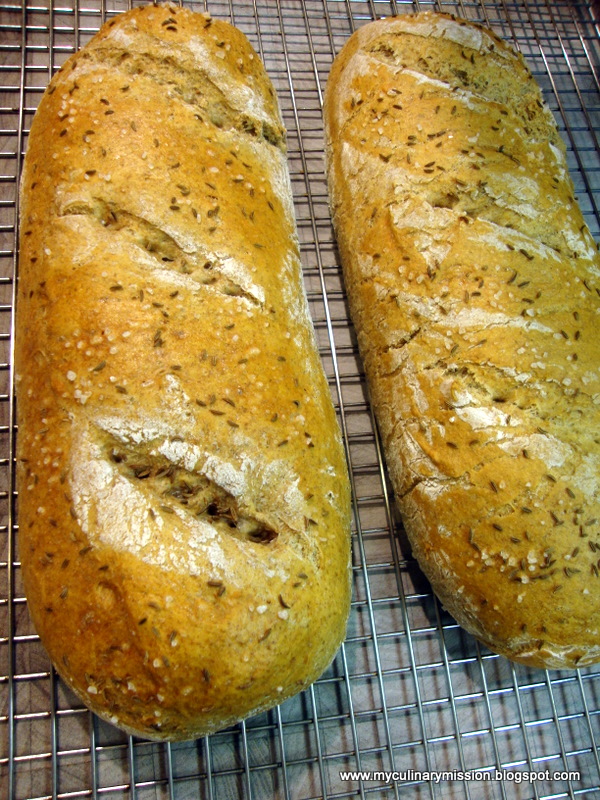
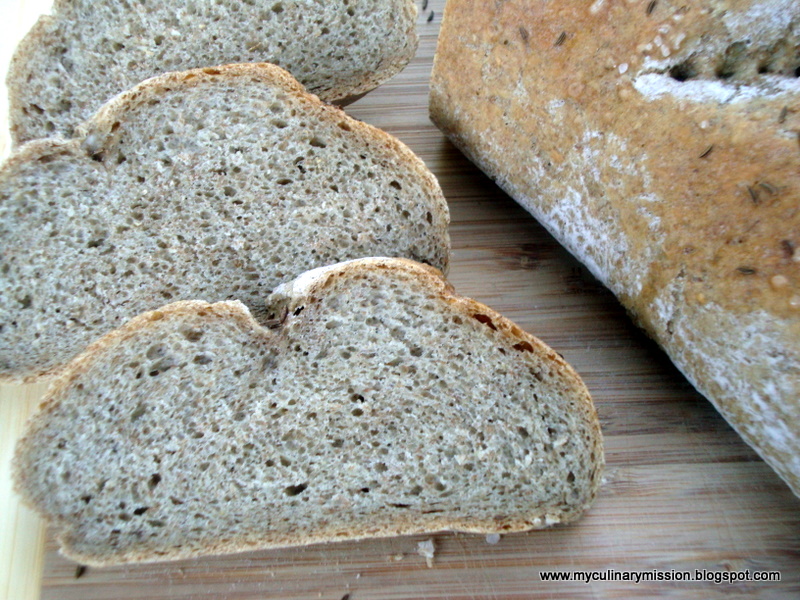
I did it!! I'm so excited! The bread is soft and chewy and the crumb (the pattern of holes inside a loaf) is perfect - no large tunnels running through it.
I think everyone should try making bread from scratch at home at least once. I chose the old fashioned way, kneading by hand, not using a stand-mixer with a dough hook. The scent of the yeast is wonderful and the aroma of baked bread is amazing.
Success meter (1-3): 3


Towels/Slings


Still too seedy after running through
a mini-processor and pestle & mortar.

Much better after using a coffee grinder.


Yeast before proofing.

Yeast after proofing - a bit dome shapped
and creamier looking.


I like to place my dough in
the oven (turned off) to rise.

First rising.

To "punch down" the dough, flour the backside
of your hand and quickly "slap" the dough
with the back of your fingers.


"Pinch" the dough after each roll
by poking the edge with your fingers.


Too fun!
If you will be baking bread often
you may want one of these.


Apparently, I did not know the trick at the time to making beautiful slashes.